

"I've wanted so badly for it to be good"
Welcome to a special Summer Session of Closely Reading, where we’re slowly reading John Steinbeck’s The Grapes of Wrath along with companion reads, all summer long. You’re welcome to join us any time. Paid subscribers will be invited to a live video chat with me at the end of the session, in August. Full schedule available here.
Get your calendar out: Paid subscriber Zoom call will take place 12pm MT on Sunday, August 23.

Dear reader,
Today, we’re taking a sustained look at chapters 24-26 of The Grapes of Wrath along with entries 64-79 in Steinbeck’s journal, Working Days.
Previous sections:
→ Chapter 1
→ Chapters 2-7
→ Chapters 8-13
→ Chapters 14-18
→ Chapters 19-21
→ Chapters 22-23
Become a paid subscriber to access:
→ Writing prompts
→ A tour of my annotations
And if you’re just getting started, here are my recommended editions to invest in:
→ The Grapes of Wrath (Be aware: this edition has deckled edges!)
→ The Grapes of Wrath (Penguin Classic: this edition has normal page edges!)
→ Working Days
Back at the café with my summer drink of choice
Saturday, noon.
At the coffee shop with the view of the mountains; live jazz music from a young trio of musicians.
An iced white mocha with strawberry syrup. Again.
In Steinbeck’s entries this week, he wonders if he needs to cut back on smoking, as he writes:
I’m afraid this book is going to pieces. If it does, I do too. I’ve wanted so badly for it to be good. If it isn’t, I’m afraid I’m through in more ways than one….
So the hell with it. Let’s slow down, not in pace or wordage but in nerves.
His articulation of slowing down his nerves, while not giving up on his work, hit me like the calming sink into a hot tub on a winter night. And by that I mean: thank god he said it.
It feels like what I’m always trying to inspire here, for us, in this “closely reading” adventure. The hell with all this optimization and speed and innovation and pushing and forcing and worrying. Let’s slow down. We can get our work done; no need to fry our nerves.
The next day, Steinbeck returns to his journal, still likely nursing that burnt blister in the groove his pen sits on his finger:
“Now—just slow down. Have been working and thinking at top speed. Must go slow.”
He said it twice; the feeling lasted not just one writing session, but for days in his entries. He’s reminding himself to slow down and I couldn’t help but recall the turtle in the early chapters. That slow and steady figure of movement.
A metaphor for the Joads, surely, carrying his home on his back like they do.1
But also, perhaps, a metaphor of our author trudging along through the pages, along the dusty road with the Joad family.
And, finally, perhaps, an invitation to us readers: be the turtle. Move slower. Give your nerves a break. Slow down. Top speed isn’t necessary. You’ll get there.
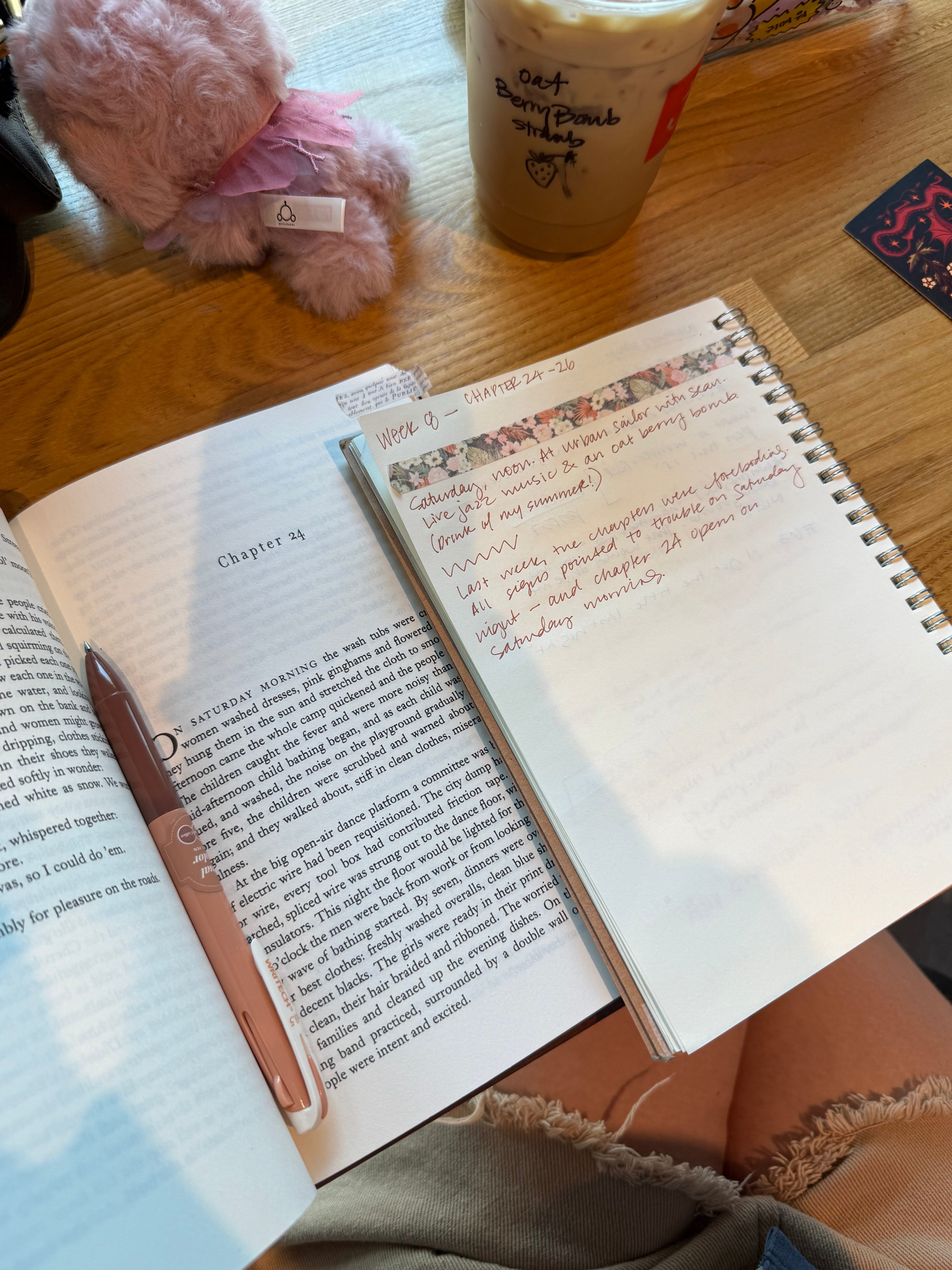
Here’s what I wrote in my reading journal as I made my way through chapters 24, 25 and 26.
Last week, the chapters were foreboding. All signs pointed to trouble on Saturday night at the dance. And chapter 24 opens on Saturday morning. I sit hitched in anxiety, waiting for the awful thing to happen. More awful things to happen.
I think 23 is my favorite chapter thus far. I like that the drive there is pleasure. That’s all the dance is: a little pleasure in the pain.
Storytellers. Amusement. Participation.
(HBO’s Station Eleven does this very effectively, too.)
Chapter 24 lights the dance floor. Makeshift electric wiring from the junk heap; reminds me of Yonnondio. Reminds me of the kids building castles in the trash.
They’re organized. Ready for the “bust up.”
There are more cops than hot water faucets and “a vagrant is anybody a cop don’t like.”
AI smiles at his reflection in the mirror and I hope he’ll be okay.
Tom’s joke about Connie studying to become President of the USA made me laugh out loud — a rare treat in an otherwise painfully sad novel.
Ma loves Rosasharn so much.
There is no dust up. Them being organized keeps everyone safe. And f*ck those losers who came in to ruin it all.
Chapter 25 is a beautiful, natural ecosystem, but is “natural” fair to say? This is an ecosystem optimized by experts, then run to rot for profit.
Okay, I think 25 is my favorite chapter now.
Optimization doesn’t create comfort or answers or stability.
It just creates waste.
Enshittification is the book about this exact same process, in tech.
“And the smell of rot fills the country.”
The title arrives right on the page in chapter 25.
God, it means so much more than I thought it would. I get what he means.
“The grapes of wrath are filling and growing heavy, growing heavy for the vintage.”
In chapter 26, that little boy is starving and sickly, in a valley filled with fruit and profits and fine homes. None for him.
On reflecting, I can’t help but notice how much I was braced for pain in the chapters about pleasure. Steinbeck has effectively taught me to understand how the Joads are living: from gut punch to gut punch. A good thing happens…but pain inevitably follows. Theirs is a life of waiting for the next blow.
And yet, even as the peaches rot on the trees faster than the starving migrants can pick them, there’s a moment to dance. There’s a rare new dress. There is sidemeat and sugar in the coffee again. The sweetness is so rare, and everyone is so exhausted. And yet they still keep going.
A new recommendation
I couldn’t put the book down after this week’s chapters, and so I am done with the novel — but I am definitely not done thinking about it. (And I’ll be re-reading the ending for next week. I needed tissues; there’s your warning.)
As we wrap things up, and as I start my own little adventure into the JSTOR world of research on the novel, I also picked up another title:
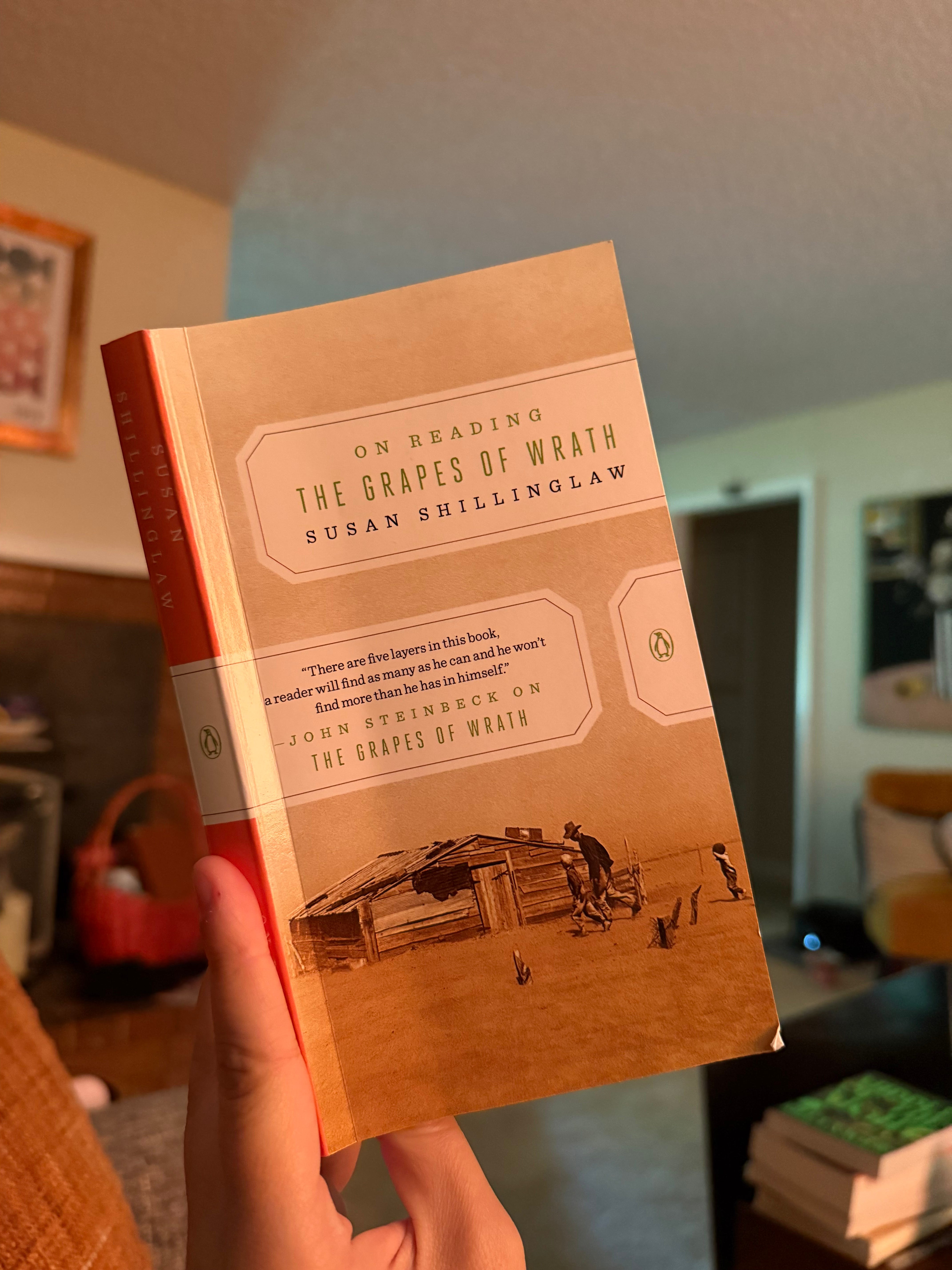
→ On Reading The Grapes of Wrath by Susan Shillinglaw
I am eight chapters in — the book flies by — and I find it really compelling. An excellent exercise in closely reading the novel, although not one I would recommend until you’re almost done with the novel, like we are.
Part of the reason is: sometimes, when someone else has done the close reading and found the things you found, you can forget you found them. Find them on your own first; then read what others say, and find your patterns and overlaps and similarities.
(In a world of AI, we’re all too invited to outsource our thinking. Let’s not.)
Shillinglaw obviously adores the novel and takes it very seriously. The language is a bit flowery, but in a way that suggests, to me, she’s passionate and has taken some inspiration from Steinbeck’s own style and prose rhythms. Nothing wrong with passion!
I like what she’s doing in the book as a “reading experience,” and how she brings you into a new framework for understanding the story structure. More on this next week, since it evokes a few spoilers. I definitely recommend it if you’re looking to take your reading of the novel a step deeper!
In the spirit of slowing down
As we near the novel’s end, I invite you to start taking a few deep breaths and slowing down…
Reflect. Set a 12 minute timer some time this week and just stare at the sky or the ceiling or your beloved dog or cat while you simply think about the novel. What scenes jump back to mind? Do you remember any phrases verbatim? No need to write anything down.
Record. Set another timer, a bit longer this time, and restore the novel firmly in your mind as we head into the final chapters. Write freely — that is, without judgment or fear of sounding stupid — and give the novel “back to yourself,” as an experience. Record your experience, taking inspiration from Steinbeck’s journals or from your own notes.
Reserve some time! A more formal invitation for our final Zoom meeting will be sent to paid subscribers in the coming days. I am planning on 12pm MT on Sunday, August 23rd. This will give everyone time to finish the novel, as well as time to review + do a little research, as desired.
The Zoom Call!
I’ll share more as I put together the invite, but I’m planning to do a bit of a “lecture” as part of our Zoom call, along with leaving plenty of time for group discussion. In the comments this week, I’d love to know about the topics or themes you’d most like me to cover. Thanks!
Meet me in the comments
I can’t believe we’re almost done with this gorgeous, strange, heartbreaking book. Tell me what’s on your mind this week in our comments, and let’s get the conversation flowing.
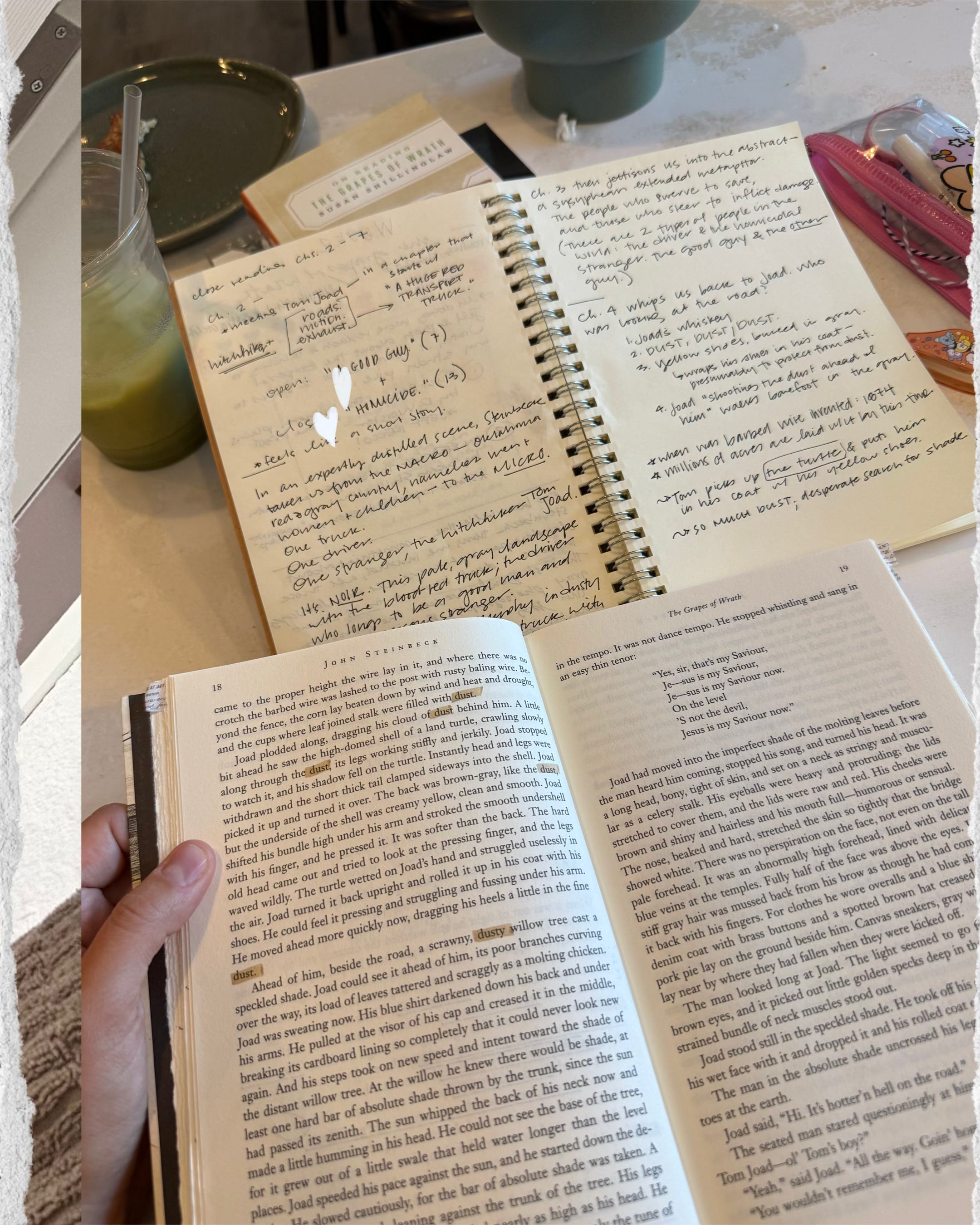
Susan Shillinglaw’s close reading of the opening chapters pointed this out; that’s when I got positively hooked on her lovely little book!