


Literary techniques abound: from noir and doubles to parables and proletarian hallmarks
Welcome to a special Summer Session of Closely Reading, where we’re slowly reading John Steinbeck’s The Grapes of Wrath along with companion reads, all summer long. You’re welcome to join us any time. Full schedule available here.
Paid subscribers will be invited to a live video chat with me at the end of the session, in August.

Dear reader,
Today, we’re looking at chapters 2-7 of The Grapes of Wrath along with a handful of entries from Steinbeck’s journal in Working Days.
As a reminder: you can read any edition or copy of the novel (used, new, audio, digital). Here are my recommended editions —
→ The Grapes of Wrath (Be aware: this edition has deckled edges!)
→ The Grapes of Wrath (Penguin Classic: this edition has normal page edges!)
→ Working Days
A huge red transport truck
We’re taken away from the dusty scene on the farm in a giant red truck, as the narrative picks up a hitchhiker named Tom Joad. Chapter 2 opens with “a good guy” (page 7) and closes with a confession of “homicide,” (page 13), giving us a wicked parallel and introducing a literary technique we’ve seen before:
Doubles, or foils.
Here, the “good guy” driving the truck is contrasted with the quiet stranger he picks up, who ends up being a man recently released from prison. This man is Tom Joad, a man headed back to the family land after a stint for accidental homicide (we learn more details of his crime later in this week’s assigned chapters).
He’ll be doubled again (and again!) by both his father, of the same name, Tom Joad Sr., as well as by his male companions that join his journey: Reverend Casy and Muley Graves.
In an expertly distilled scene at the open of chapter 2, Steinbeck takes us away from the macro — that paling Oklahoma countryside filled with nameless men, women and children — into the micro.
One truck.
One driver.
One stranger — the one about whom our story will presumably unfold. Tom Joad.
The scene in the truck feels like a noir film: a pale, grayscale landscape across which a blood-red truck drives in the blazing sun. The driver longs to be a good man. The dangerous stranger withholds and confesses on a whim.
My mind couldn’t help but play with the casting of the scene.
Give me Woody Harrelson in the stranger’s seat; Cillian Murphy in the driver’s. (Or, stay with me here: Cherry Jones as Tom Joad. You can’t tell me you don’t wanna watch that!)
“Yesterday turtle episode which satisfies me in a number of ways. Today’s project — Joad’s walk down the road and meeting with the minister.”
From Working Days, Entry #3
Chapter 3 veers us right back into the macro: a bizarre and, yes, “satisfying” little parable of two types of people in the world. The ones who swerve to miss a turtle crossing the road, and the ones who swerve to hit it.
Chapter 4 takes us back to Tom Joad — perhaps the third type of person in the world. The one who wraps the turtle in his coat with a pair of bright yellow shoes, taking it home for the kids to play with.
After writing a few more days, Steinbeck decides: “Turtle sequence stands up.” (Entry #4)
The turtle is doing something in the novel. I can’t quite decide if I want to make my mind up about what it is, just yet, but it points at a few key themes we’ve noticed (or are ready to notice) given the novel’s subject matter:
Slow migration toward some unknown destination that tugs at you
Moving at a turtle’s speed in a world of fast-moving cars
Whether you’re hunting or being hunted (by cars, by cats, by the sheriff with his flashlight)
What is valuable: one man’s target practice is another man’s gift
We meet Jim Casy, a “Burning Busher” who “aint got the call no more.” A preacher who can no longer preach, but who waxes philosophical in a strong Southern dialect throughout our chapters this week.
He’s there, Steinbeck writes in his journal, for good reason:
“Casy the preacher must be strongly developed as a thoughtful, well-rounded character. Must show quickly the developing of a questing mind and a developing leadership.”
From Working Days, Entry #3
So far, Casy absolutely builds against this planned development: he’s a thoughtful, quick-witted man who seems to play well off of Tom Joad’s quietude and mystery. Casy is right there on the page, and is now set to accompany Tom to find the missing Joad family. That, to me, suggests a spark of a “questing mind.”
My own questing mind leapt to a comparison: Chaucer in the fantastically underrated film A Knight’s Tale with Heath Ledger. In it, the same actor (Paul Bettany) who plays Vision in the Marvel-verse plays a rugged, witty Chaucer who often gambles his clothing away and has a gift for crowd work.
His pleas to the crowd, his loss of faith, his gawky gait read very “Jim Casy” to me now.
Casy’s existential crisis ripples on the page, echoes of something that feels deeply “American” in its textures and tensions. The death of the Holy trinity; the loss of faith; the wonderment that humanity may be all we’ve got.
“Maybe it ain’t a sin. Maybe it’s just the way folks is. Maybe we been whippin’ the hell out of ourselves for nothin’.”
From The Grapes of Wrath, chapter 4
Chapter 5 takes us back into the macro — another parable, this time of the Banks and the Companies, with their gaping maws, starving always for profits.
“The monster has to have profits all the time,” the owners tell the tenants.
There are no particulars here, no specific characters. There is only the typecast of the stage, the play in progress, one we all know only too well, the same one on the stage today, the drama dedicated as ever to the monsters and the machines.
If you’ve ever wondered what the proletariat is, or what Bo Burnham was singing about, or why George Banks was so horrifically torn to emotional bits in Mary Poppins, well, it’s all here in Chapter 5, the same one Steinbeck refers to in his journals and says “must have a symphonic overtone,” in order to work.1
This chapter, for me, conjured comparisons to unexpected literary connections, like the way Jean Rhys writes about techno-fascism in Good Morning, Midnight or how Kafka portrays the labyrinthine bureaucracies of the mid-20th century in The Trial.2
Steinbeck manages to put a whole dystopic world into plain view in just a few pages, and the worst part is, it’s not a fantasy. There are no human-sized cockroaches or surrealist nightmares; there are simply the roles we surely recognize readily in late-stage capitalism. Perhaps we see them as readily as the roles Steinbeck knew in a barely-more-nascent stage of it, in the 1930s.
These monsters corrupt all connection in the name of inevitability, in the name of ever-increasing margins.
(This is, yes, very much, the exact same narrative our present-day tech bros spout without a seeming ounce of self-awareness, as they demand we adopt AI and use AI and care about AI and “don’t get left behind” in this “inevitable” epoch of new technological advancement. The consequences have been, are, continue to be the same: from data center drought to forced displacement to continual disenfranchisement. Yes. It is all the same old story.)
The chapter systematically details every little wrung on this vicious ladder from human to total dehumanization under a machine.
→ There is alienation between the father and his wife and his children
→ There is the violent separation of humans from the land they live on
→ Steinbeck even leverages the language of sexual assault to portray the grave cruelties of industry on society, compellingly suggesting that in the wake of unrelenting capitalism, we’re left with a dusty gray void — a once meaningful, loving, prayerful, beloved place is left to nothingness (not hatred, but something far worse: the indifference of corporative imperative).
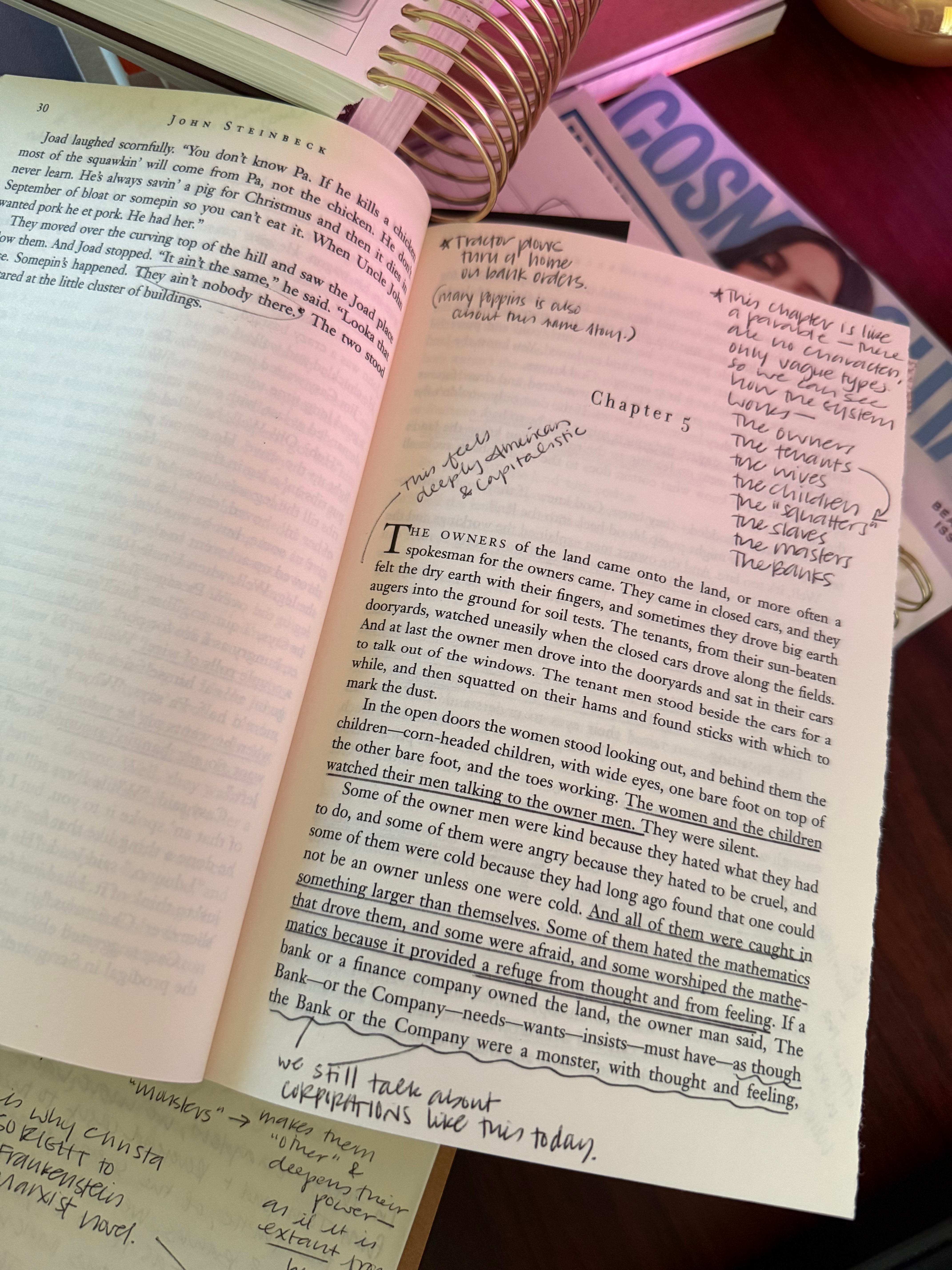
In these chapters, we move between Tom Joad and Reverend Casy, to parables of turtles and swerving cars, of machines and tractors and faceless Bankers
It is as if, through this narrative shifting from macro to micro, Steinbeck forces us to experience the story on two dimensions: the system and the lived story. The Banks and the Joads.
Expertly, Steinbeck weaves the micro and macro back together — like when Tom picks up the turtle from the street episode, or when we realize the home symbolically smashed by the tractor in the machines chapter is the actual physical home of real people who have been run off the land by a company that cares nothing for them.
It’s not just the Joad family impacted, though.
As soon as we feel the sting of the real in the fiction, we’re told of the stray cat who has nowhere to go. There are no “neighbors” anymore because there is no longer any social knitting together of this place — no dances, no weddings, no dinners or parties.
In case we missed it in chapter 1: this is not a novel about the dances and the parties and the joy. This is a novel about what happens when the system is not designed to serve real people. This is a story about being forced out; returning home to dust; forced migration.
The chapters for this week close on a new opening: this party of men will embark on a journey together, to find the Joad family, with Casy promising: “where folks are on the road, I’m gonna be with them.”
(Now that’s a preacher I can get behind!)
Tell me about your week with these chapters
And we’ll get the conversation going in the comments.
As always, thank you for reading with me and with each other. It’s a sincere honor to read and learn with you!
More to explore
“Extra credit” posts with homework assignments and free writing prompts
A comprehensive reading list of “what to read after” The Grapes of Wrath
An invite to a live Zoom meeting to discuss the novel in August
The full archive of all past book guides + essays (including full read-a-longs for Pride & Prejudice, The House of Mirth, The Age of Innocence, Middlemarch, McTeague, Passing and more…)
Become a paid subscriber to access it all!
📚 $25/year | The classic close reader
✨ $50/year | The sustaining member
Perhaps you were also reminded of Life in the Iron-Mills and Yonnondio, two of our prior reads?
Very much recommended reading!