

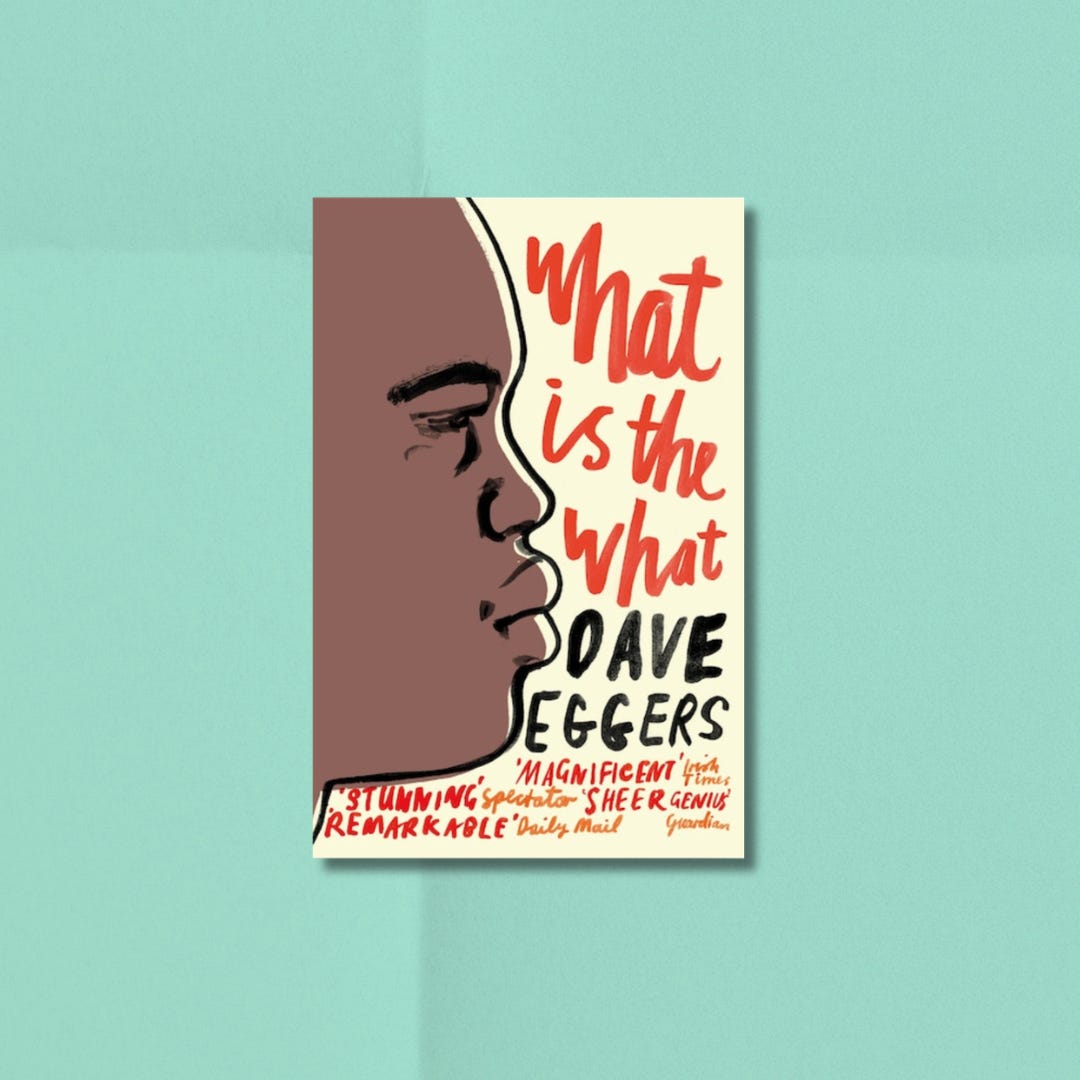
A gutting autobiographical novel you will never forget
The one time I make plans for my publishing schedule, I read a book that stops all rational thought and makes me wonder how I have the audacity to complain about the things I complain about.
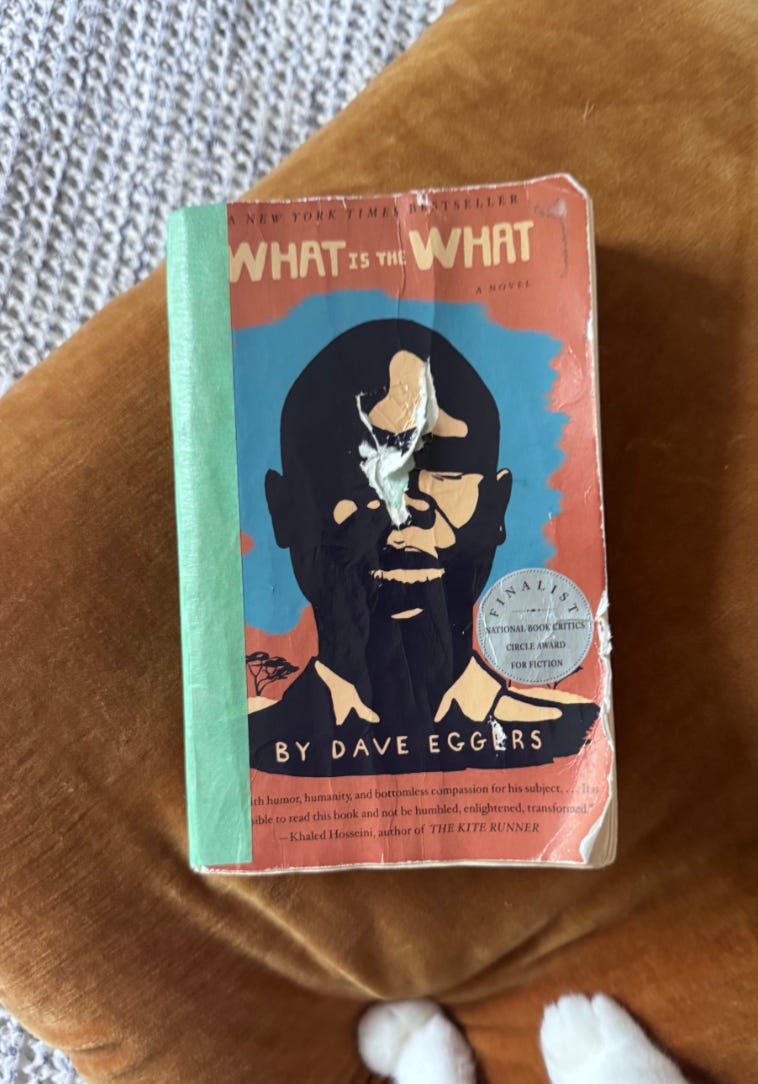
That is to say, I read What is the What by Dave Eggers and I don’t imagine a day in my life when I won’t remember reading it.
I love Dave Eggers. I love his memoir (I included it in last week’s list of 40 books that made me.) I love McSweeney’s, the literary journal and phenomenon he founded (read I Watched the Copa Mundial Non-Stop on Telemundo for Cinco Weeks and Now I Don’t Hablar Inglés Anymore and try not to laugh.) I love his youth writing program, 826 National. I even love his art and wish I had an extra $700 to purchase this weird print.
Given how much I like his work, it’s strange that I’ve had one of his novels on my bookshelf for at least 10 years and haven’t read it until now. I’d forgotten about it until I was reading A Long Walk to Water and got into a conversation about the Lost Boys of Sudan with a friend. He told me he loved What is the What, a book about one of the real-life Lost Boys. I pulled it off my shelf that afternoon.
What is the What is the story of Valentino Achak Deng, a refugee who escaped a militia takeover in his South Sudanese village at age seven. Torn from his family, Valentino, along with thousands of others, walked his way into becoming one of the Lost Boys of Sudan, a name bestowed upon the 20,000+ boys who fled South Sudan by foot.
Having lived a hundred lifetimes by the time he made it to the United States (this is not a spoiler), Valentino wanted to share his story to shed light on what was happening in South Sudan. Through a connection at The Lost Boys Foundation, he met author Dave Eggers. What a life-changing connection that was.
Dave and Valentino worked together for 18 months before landing on the form the book would take: a fictionalized autobiography in Valentino’s voice. Over the course of many years, Valentino shared his story with Dave via tape recordings, phone conversations, and several in-person meetings. In 2003, two years after arriving in the US and three years before What is the What was published, the two traveled to the town Valentino had escaped from nearly two decades prior. It was his first time returning to his village.
“I told Dave what I knew and what I could remember,” Valentino says, “and from that material, he created this work of art.”
Fiction, when done right, has the ability to reflect reality better than nonfiction. Dave was able to portray real conversations in the form of a readable narrative that autobiographers can’t get away with. I tend to be critical of the dialogue in memoirs because I know the conversations couldn’t have been preserved so accurately. But in this case, readers can buy both the conversations Valentino had (because, theoretically, they aren’t real) and absorb the impact they had on Valentino’s life (because, theoretically, they are based on real experiences).
What results is a fictionalized autobiography that is representative of the unbelievable life of Valentino Achak Deng.
What is the Why?
In the preface of the book, Valentino writes that even when his hours were darkest (and OH MY GOD, his hours were abyssal), he believed someday he could share his experiences with others. “This book is a form of struggle, and it keeps my spirit alive to struggle. To struggle is to strengthen my faith, my hope and my belief in humanity,” he says.
Valentino tells his story through public speaking, but the book is something else altogether. Artist that he is, Dave uses a particular literary device to weave between the present and past: he grounds readers in the present storyline, which finds Valentino beaten and bound on the floor of his apartment in Atlanta, by addressing the person who happens to be nearby in the present moment. But he does this all in his head, as he’s not actually spilling to his aggressors what it was like to swim across the crocodile infested Gilo River or watch his friends close their eyes and become one with the earth.
Here’s an example. When he’s lying on the floor of his apartment, he addresses his roommate Achor Achor, who isn’t home. “Achor Achor, I don’t want to curse you but this situation would be much different if you saw fit to come home.”
Later, he addresses the young boy who broke into his home with two adults and watched TV while they loaded their car with Valentino’s belongings: “Michael, I have little patience left for you. I am finished with you, and wish you could have seen what I saw. Be grateful, TV Boy. Have respect. Have you seen the beginning of a war? Picture your neighborhood, and now see the women screaming, the babies tossed into wells. Watch your brothers explode. I want you here with me.”
Then he tells a story about sitting with his mother and helping her boil water, back when he lived in South Sudan and knew whether or not his mother was alive. In this way — by addressing various people throughout the present storyline, almost as though he were writing them a letter — Valentino both lives in Atlanta and revisits his time dodging bullets, watching boys tear skin off an elephant to eat the meat beneath, walking 1,000 miles barefoot, and spending years at refugee camps in Ethiopia and Kenya.
What is the What?
The title of this book is a puzzle that takes a lifetime to solve. Valentino seeks to understand “The What,” or the intangible unknowing of what life is about. It’s intentionally murky. What could be the purpose of throwing a seven-year-old out of his village and amongst militiamen and lions and so much worse? What could Valentino have held onto that would justify what he endured? That is The What.
Twenty years have passed since this book was published. Since then, Valentino has gone on to co-create (with Dave) the VAD Foundation, be honored by Barack Obama at the White House, deliver a TEDx Talk, build the Marial Bai Secondary School, marry and have four children, become the minister for education in Northern Bahr el-Ghazal, and undoubtedly so much more.
All proceeds from the book go to the VAD Foundation, funding Valentino’s work to improve the lives of Sudanese wherever they have fled.

“Since you and I exist, together we can make a difference!” Valentino says in the preface. Purchase What is the What or request it from your library. Get involved with the VAD Foundation. Tell your friends about Valentino Achak Deng. Forward this to someone who needs to hear Valentino’s story.
In the book, Valentino says, “it gives me strength to know that you are there. I covet your eyes, your ears, the collapsible space between us.”
I feel the same about you.
Questions for you:
What novels have you read that have illuminated real historical events for you?
When What is the What came out, there was a discourse around Dave writing Valentino’s story and how the voices got jumbled. Do you think a story is best written by the one who lived it?
Have you ever read a book that’s interrupted your life and challenged your ability to think about anything else? Share in the comments!
Thanks for reading! Love, Kolina
- What are you reading? What are you underlining?
- What I’m reading: The Obsessed by Lizzie Buehler
When you purchase books through the links above, you support The Underlined and an indie bookstore of your choice at no additional cost to you.


