

The Margins: Thao Thai
This is The Margins: a series where I get to sit down for casual conversations with my favorite authors about their books, their writing lives, and, of course, their book recommendations.

I’m very excited to be sharing today’s issue of The Margins with you because it features one of my favorite novels I’ve read this year. And that is saying a lot because we have been spoiled with new releases this year.
I’m a sucker for novels about art. Pair that with family secrets, history, and sibling dynamics, and I’m almost guaranteed to pick it up. Thao Thai’s newest novel, The Seekers of Deer Creek (out today!), brings all those threads together in a lush novel that I tore through in two sittings.
I’ve been a fan of Thao’s writing ever since I read her debut, Banyan Moon, back in 2023. I immediately fell in love with her writing and lushly drawn settings. Below, Thao and I talk about creating a fictional artist whose work feels startlingly real, the role art plays in preserving and reshaping history, the small details that bring her characters to life, and, of course, the books she’s been loving lately.
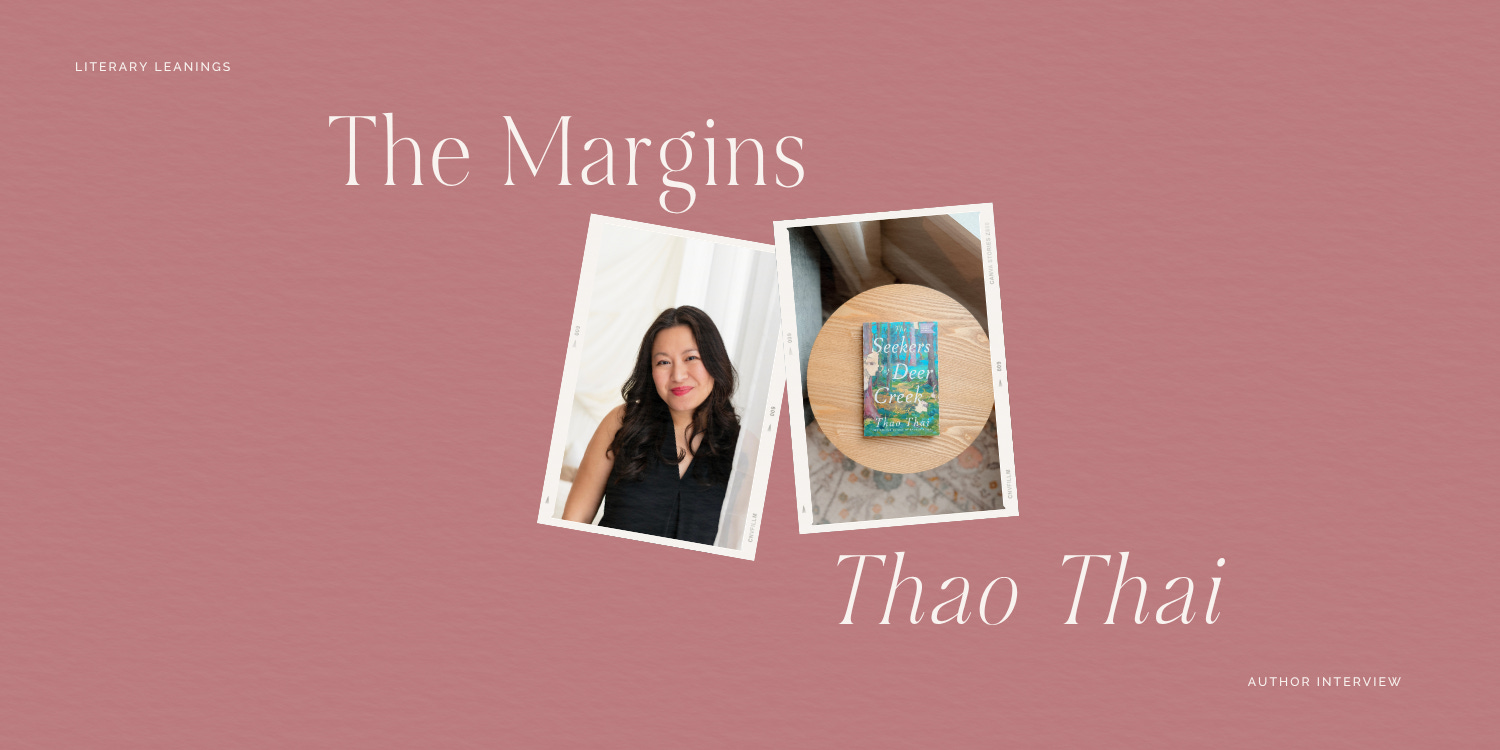
Hi Thao! Thanks so much for joining us for this issue of The Margins. I’m so delighted to have you here. Congratulations on the publication of The Seekers of Deer Creek! For readers who may not know you yet, could you introduce yourself and tell us a little about your novel?
Thank you so much, Michelle! Very happy to be here. I’m a novelist and writing instructor living in central Ohio with my family and my badly behaved cats. The Seekers of Deer Creek is my sophomore novel. I like to describe it as an art mystery wrapped inside a family saga. The book tells the story of two estranged sisters, Vivi and Calla, who are forced back together through the appearance of one mysterious, Surrealist painting that held great meaning for their recently deceased father. To uncover the secrets behind their father’s inexplicable obsession with this painting, they are flung on a whirlwind journey that takes them to the hallowed halls of the Chicago galleries, an estate on the French countryside, and a crumbling house on the edge of a ravine in Vietnam. It’s a tale of sisterhood but it’s also a tale of making art, despite all that life throws at us.
One of the questions that reappears throughout the novel is “what is art for?” Some characters approach it as preservation, others as prestige, others as a way of making sense of themselves or their histories. Was that question at the heart of the novel from the beginning, or did it emerge as you were writing? And has writing this book changed the way you think about the purpose of art?
This was going to be a sister story from the start, but the art piece didn’t slot in until later. I’ve worked as a designer and I was once an art history student, so museums and art objects are woven into the way I make meaning of the world. Once I understood that art would serve as the preoccupation and vocation that tied the sisters together in this novel, I began to see it as a vehicle for their expression and also as a point of contention between them. Art is slippery; it’s never one thing. Our understanding of a piece changes on each viewing; deepens, shifts, contradicts. That’s the beauty of the discipline. It resists translation and invites reinterpretation. As for how I think of art: I never truly considered myself a capital-A artist. But I’ve begun to think of myself as a maker of art, whether that’s in my watercolor sketches, my photography, my sewing and embroidery, or my kitchen experiments. I learned to expand my personal definition of what art could be and how artists should practice.
I loved how vividly you wrote about visual art in the novel. K.P. Lý isn’t a real artist (at least from my Google search!), but by the end I felt as though I’d seen the paintings. How did you approach inventing both the artist and the body of work? Were there particular artists or paintings that influenced you?
Thank you for this! A friend said the same about googling K.P. Lý and I’m so gratified to see that the illusion holds! I could see Lý’s work very vividly from the start. For a time, I helped edit catalogue copy at a gallery and that experience, combined with my studies in art history, helped me find the language for describing art. I spent a lot of time researching Surrealist painters like Dalí and Carrington and was immediately drawn to the psychological intertwining of dreaming and trauma. The veil between our imagination and reality can be whisper-thin sometimes. I imagine Lý would have felt himself to be a traveler between the two realms—or, maybe an exile of both.
From the beginning, I admired how economically you reveal character. We understand the characters through the smallest observations—Calla through the scents Vivi notices on her, Tuấn through his hand injury—and those small details tell us so much. When you’re introducing a character, how do you decide which details deserve to be on the page?
Forgive the art metaphor, but I feel that my writing style tends to be more impressionistic. I try to aim for selective, emotion-forward moments of a character versus trying to capture a photorealistic rendering. When I teach, I tell my students that specificity matters so much when we’re painting a scene with our words. It can’t just be a generically good smell. It has to be a smell with layers and history, one that pushes and pulls, as Calla’s signature citrus perfume does for Vivi. I write this way because I think it’s the way memories work, too. It’s impossible to hold the entirety of a person, place, or experience all at once. Our brains naturally pick out pieces and parts and construct those bits into an impression that also contains something of ourselves.
Near the middle of the novel, Vivi encounters versions of herself through other people’s art: a street artist’s sketch, a friend’s photograph, and a child’s drawing. What does it mean to Vivi—and you—to continually see herself in other people’s eyes?
What a perceptive question; thank you for asking it! Vivi is afraid of staring too deeply into her reflection. She’s a character driven by such deep-set shame that a good, hard look is enough to disrupt her carefully constructed world. This is why Calla is such a fascinating counterpoint for her—no one sees you as clearly as a sibling, I think, especially a sibling like Calla, who refuses to mince words. Because Vivi fears discovery, it was interesting for me to see her confronted by others’ depictions of her. She has to grapple with what feels true and what feels like a fiction she’s spun. She can’t turn from herself. But being seen is a gift, as much as it is a burden. I know I’ve learned so much about myself through others’ eyes, for better or worse, but in the end, I’m always grateful for a witness, even if the reflection smarts.
The excerpts from K.P. Lý’s journals have such a distinct and personal voice from the rest of the novel. How did you find that voice? Did writing those sections feel different from writing the contemporary storyline?
You know, this book has changed a lot from my first drafts—I’m talking massive structural changes, gutting of characters. But the journal entries never changed; they are the only element that’s remained static. In the way that Lý’s art felt so familiar to me, like something I’d seen in a dream, another life, his voice was also deeply known, almost eerily so, as if I’d encountered him before. I felt his story was essential to the heart of what the sisters were circling around. He was the disappearing compass. The sometimes-unstable moral center. I asked myself: if he held the key, where would that open door lead Vivi and Calla? I loved writing the historical voice. As a reader raised on Austen and Bronte and Dickens, I have a slightly antiquated inner monologue anyway, so Lý’s entries came naturally (and delightfully!).
The image of deer, and especially the antler ring that the sisters share, keeps resurfacing throughout the novel. Even the town itself, Deer Creek, seems to carry symbolic weight. What drew you to deer as the novel’s central symbol and what did they mean to you?
The first line and image we get in the book is of younger versions of the sisters running through the woods. In my mind, that picture elided with images of leaping deer casting shadows on the forest floor. The freedom, the grace. Also: the vulnerability and in-betweenness of deer in flight. Are they playing? Are they hunted? That line between survival and joy is an important one for the sisters too. Maybe it’s an important line for all of us.
And, of course, I’d love to ask you for some book recommendations. What’s a book you find yourself recommending again and again?
I can’t stop recommending Almost Life by Kiran Millwood Hargrave. It’s a love story spread across a few decades, about two women who unite in Paris time and time again. The characters are so rich and captivating—and, a bonus, there’s art woven throughout the narrative too!
What’s a book you love that you think more people should know about?
I absolutely adored They Dream in Gold by Mai Sennaar. Another love story, this time about a couple drawn together through music and their shared pursuit of home. The voice is breathtakingly alive. A whirlwind of color and music and personality; truly original.
And finally, what’s the last truly great book you read?
My author-friend Nathaniel Ian Miller recommended I Who Have Never Known Men by Jacqueline Harpman and even though it’s not typically my sort of book, I fell wildly and unexpectedly in love with it. The novel is from 1995 and tells a slim tale of a dystopian world where forty women are trapped together in an underground cell. The book grapples powerfully with questions of community and preservation amid a strange, barren backdrop I can’t stop thinking about.
Thank you so much, Thao! It’s fascinating to hear more about how this richly drawn novel came into existence. It’s one I’ll be thinking about for a long time! Thank you so much for chatting and I hope you enjoy pub day!
You can learn more about Thao and her work on her website and follow her on Instagram and Substack.
Are you planning to read The Seekers of Deer Creek? I’d love to hear your thoughts below!
Until next time,