
we are all magpies & this is not a pipe
Dear reader,
A few weeks ago, you perhaps finished reading McTeague with me. And, perhaps, you’re still thinking about it.
Good books have a way of sticking with us, that way.
I’m definitely still thinking about it, and in particular, I’m thinking about the gold in the novel and what to make of its many faceted appearances: from the gold pieces Trina lovingly scrubs clean and the fillings McTeague places in teeth, to the fantasy dishes from Maria’s childhood in Mexico and the glints of promise in the stream McTeague seems to strike upon by total accident.
The yellow canary; the enormous gilded tooth.
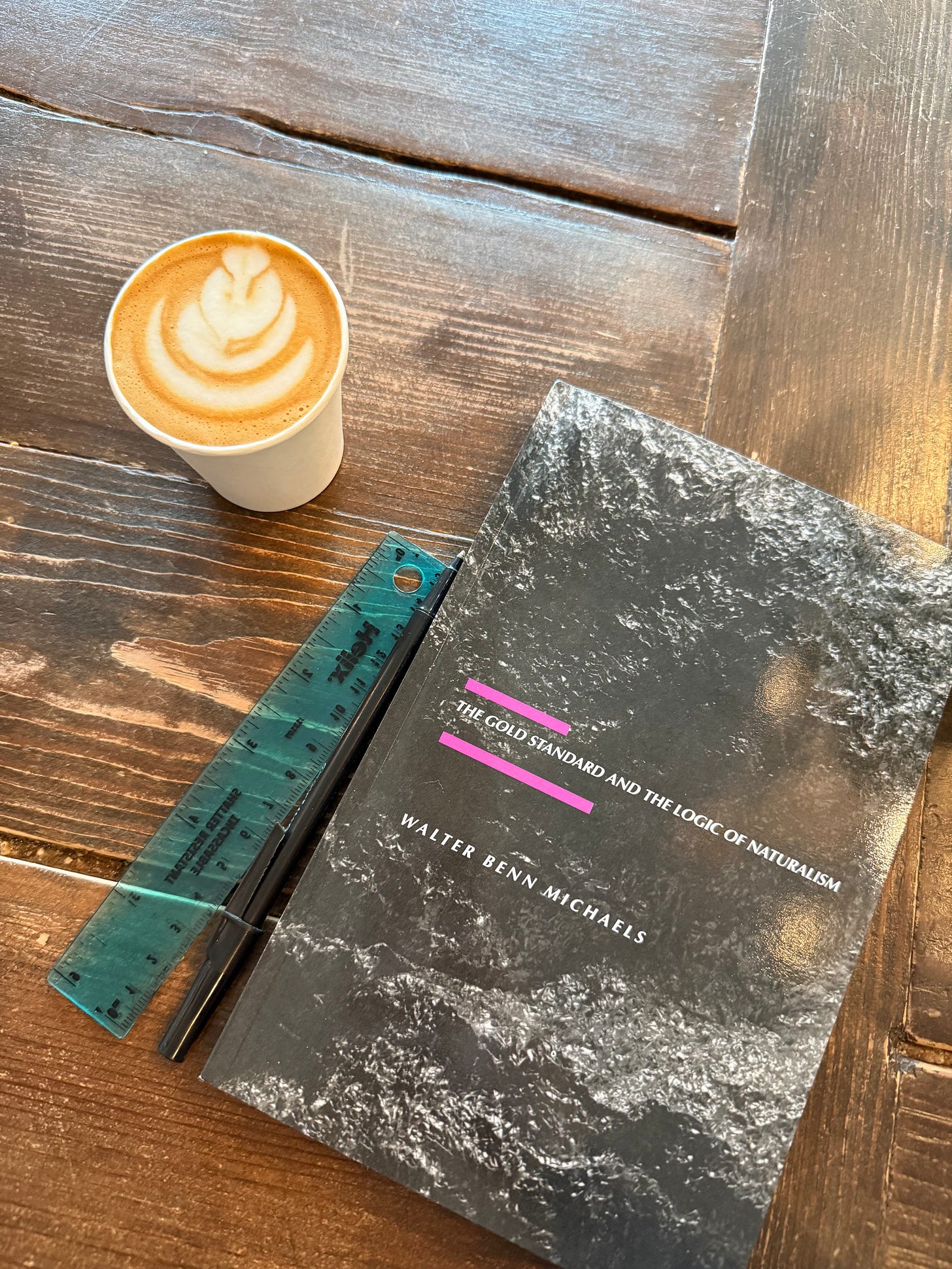
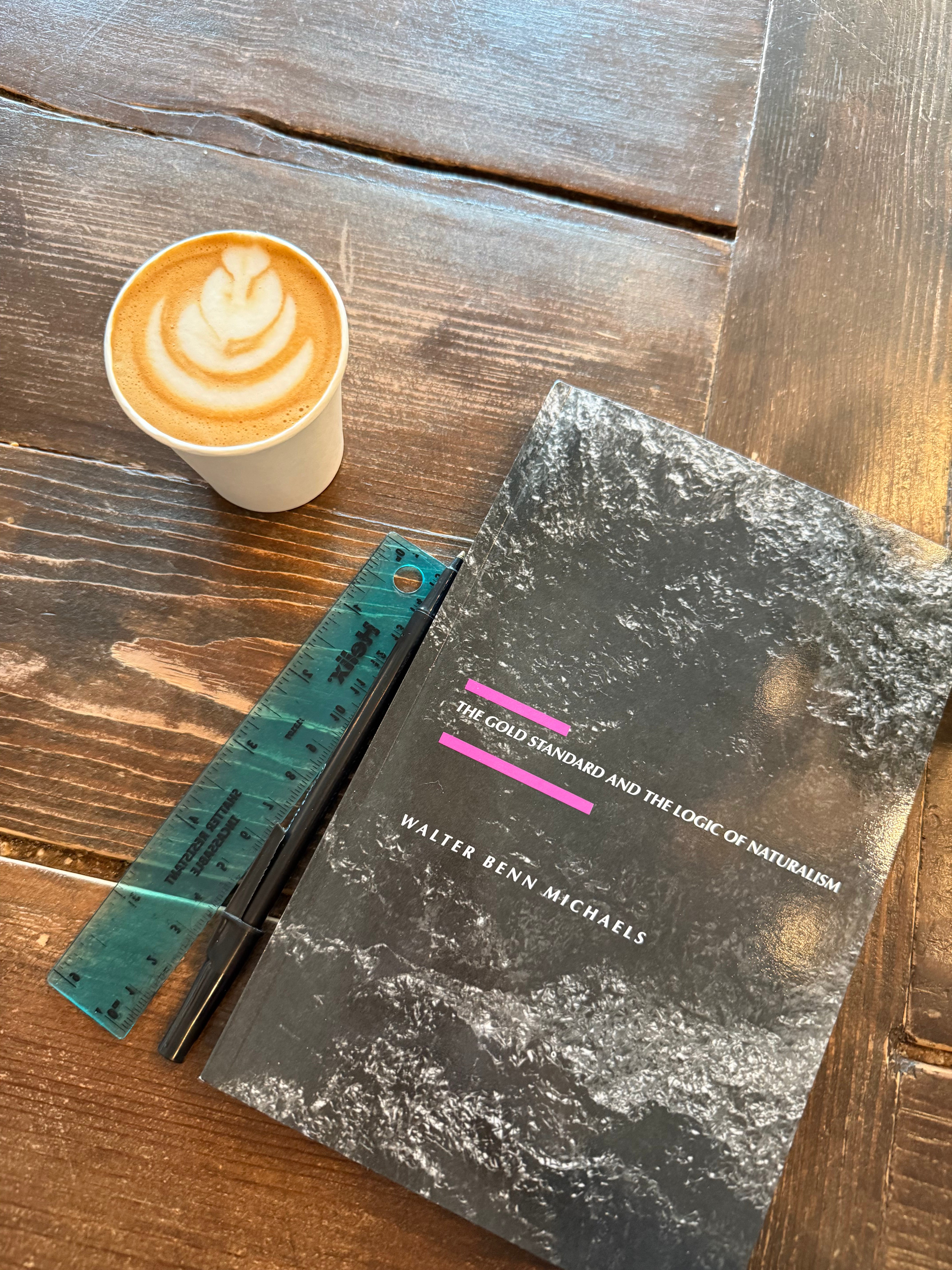
So, I turned to a classic academic text, beloved by every Naturalist professor I ever studied with but had not yet read myself: Walter Benn Michaels’ The Gold Standard and the Logic of Naturalism.
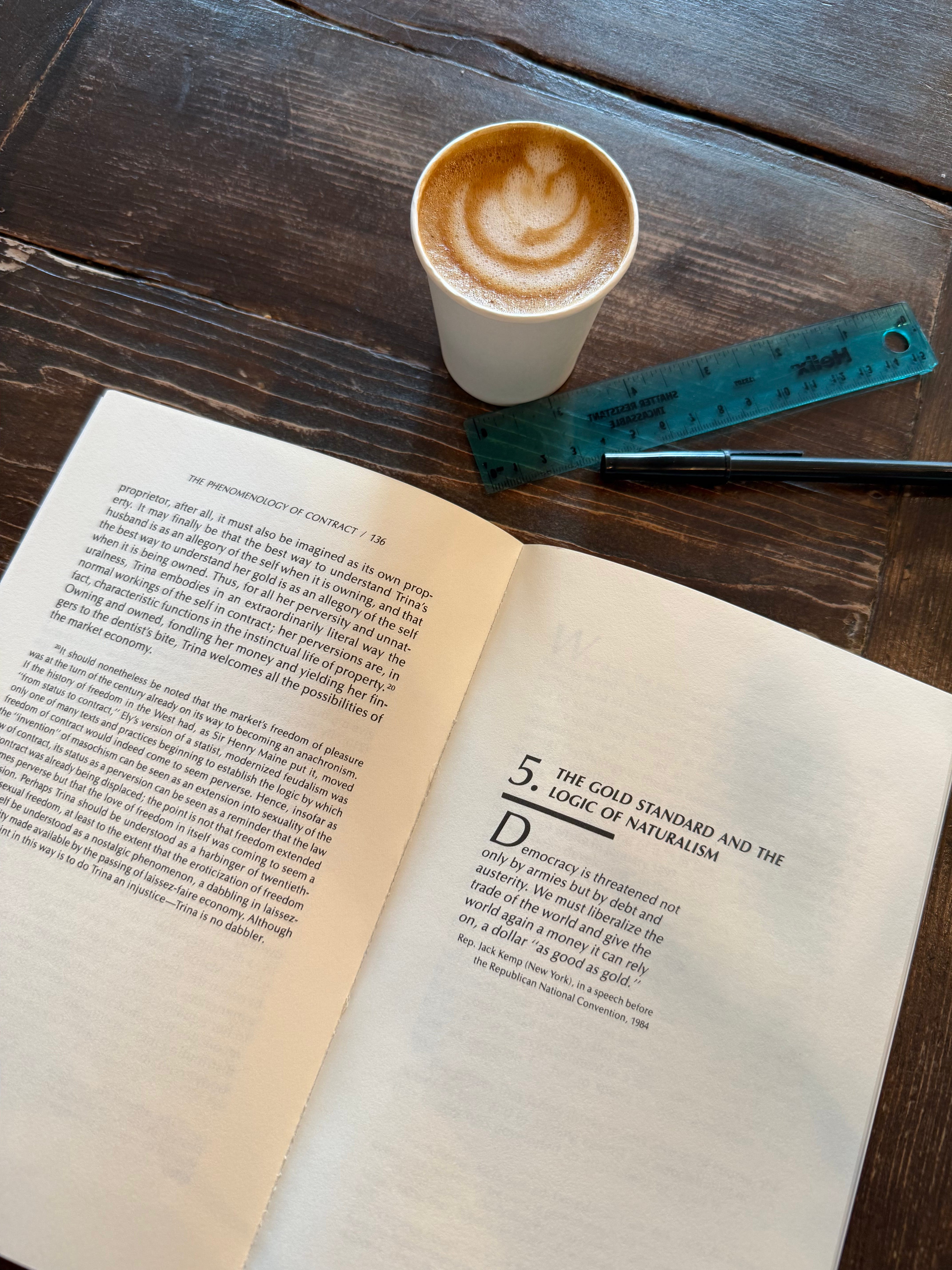
Yes, I do recommend it. Especially if you have the chance to read it with a hot oat milk cortado, like I did, on an overcast Sunday morning.
This is a classic academic monograph, and by that, I mean it’s a classically straightforward work of literary criticism: written by one scholar, about a singular topic on which that scholar has (at least somewhat) joyfully obsessed, replete with close readings of key novels to the study.
In this case, McTeague figures, in the titular book section, as central to Michaels’ reading and discussion of American Naturalism. Two of Norris’s novels get treated with deep readings here: McTeague and Vandover and the Brute (which I have not yet read). Broadview Press tells us the latter is about:
Written circa 1894-95 but published posthumously in 1914, Frank Norris’s Vandover and the Brute presents an unflinching portrait of unconventional sexuality, moral dissolution, and physical degeneration. In the setting of turn-of-the-century San Francisco depicted in Vandover, disaster encompasses far more than the vivid accounts of shipwreck or earthquake that appear in the novel. The slow wasting away of characters who contract syphilis, the suicide of a young girl, and the murder of a man clinging to a lifeboat fascinate readers today as much as they did a century ago, when this scandalous novel was first published. The most complete wreck is Vandover himself, whose artistic talents and constitution collapse after orgies of drink and sexual abandon.
Sounds quite a lot like McTeague, doesn’t it? I wonder if there are pool balls in that one…
One of my favorite things about Michaels’ reading of McTeague’s key tensions is the way he makes sense of gold and economy in the novel. Because I entered the criticism with a few key questions on that front:
→ How does the novel’s obsession with material things — junk, belongings, hoarding, losing everything — tell us about the capitalistic logic of the novel, and of St. Francisco at this time?
→ Why does Trina hoard, but never spend, her money? Why does McTeague steal it, just to carry it around without spending it?
→ What does this novel have to do with the shift from metal to paper money, which was happening around the same time period? The Gold Standard Act of 1900 feels like a critical historical backdrop for the novel. It was the moment the U.S. officially adopted the gold standard, making gold the sole basis for paper currency.
W.B. Michaels answers all these questions and made me ask new ones I hadn’t considered yet. (This is among my favorite reasons to read academic texts, even when you’re not a student anymore. They teach you so much — even if just to keep asking weird, curious questions about novels.)
Let’s look at how Michaels answers each of my key questions.
1. Materiality and capitalism
Michaels quotes William James (Henry’s brother, Father of modern psychology), who once said:
“What house does not contain some drawer or cupboard full of senseless odds and ends…with which nobody knows what to do, but which a blind instinct saves from the ash barrel?"1
There’s much connection here to Zerkow’s junk piles and Maria’s tales of gold service; the apartment that fills up and then empties of the McTeagues’ belongings. The detritus of the city, the heaps of gains and losses that make up the novel’s pages.
James makes the point that we’re all magpies: we tend to collect the little trinkets and treasures we come across, and then, without being able to articulate exactly why, assign value and meaning to those treasures.
(Marie Kondo has much to say about this.)
The essay is less about these themes, and more about economics and gold. Yet I found unexpected connections here to Tillie Olsen’s Yonnondio, especially when it comes to considering the way materials gain or lose value depending on an individual or family’s stability, class standing, and cultural background.
I recall the gorgeous, depressing scene in Yonnondio when the children play in the filthy dumpster, finding treasures to haul into the castle they’ve built from junk, unwittingly developing a miniature economy, complete with winners and losers, that mirrors the larger capitalist system in which they live.
In McTeague the metaphor is hardly less subtle than a smack in the face, especially when Zerkow kills Maria in a fit of rage because he’s become so obsessed with gold that never existed.
“Zerkow,” Michaels asserts, “doesn’t really deal junk; he collects it….His real passion is, of course, for gold, but instead of trying to turn his junk into gold by selling it, he keeps it around him as if it were already gold” (153).
2. Trina’s hoarding
I was absolutely stunned to find so much crossover with my reading of Lily Bart in the way Michaels explains the underlying desires that fuel Trina’s hoarding.
For Michaels, Trina and McTeague are the same in the sense that they both remove gold from circulation: they stunt economic flows of money by either, like Trina, hoarding gold in the floorboards, or like McTeague, planting into teeth rather than into the bank. (Remember how this particular use of gold in dentistry bothers Maria and Zerkow, especially Maria, who steals from McTeague’s parlors every chance she gets?)
McTeague even, eventually, returns the gold to the earth — in Death Valley, the hoard of gold on his back will go back into the ground, making this final action that of an “anti-miner,” who rather than extracts gold, gives it back to the ground it came from.
That’s some exceptionally funny irony.
For Michaels, this behavior can be best explained as “taking pleasure in the abstract power of money itself, the absolute means of buying.” In a way, he means that Trina wants to have buying power, but doesn’t want to buy anything. Because spending her gold would mean she loses buying power.
I was stunned to find myself suddenly thinking about Lily Bart, of Edith Wharton’s The House of Mirth who, like Trina, longs to understand value — her own, on the marriage market, and her own, as a woman in an economy run by men.
As Michaels puts it, this is “The desire to live up to the look on your face (to become what is written on your face) is the desire to be equal to oneself (to transform that writing into marks).” And it sparks questions, as ripe today as they were in 1900, about how we make and assign value to ourselves and to our lives:
“When we love glittery objects, we love beauty; when we love objects that look like other objects, we love representation” (156)
Across the larger thematic thrust of the essay, in which Michaels also invokes Theodore Dreiser’s Sister Carrie (1900), I found this reading the most compelling, and most applicable to my own interests in the literature of the time period.
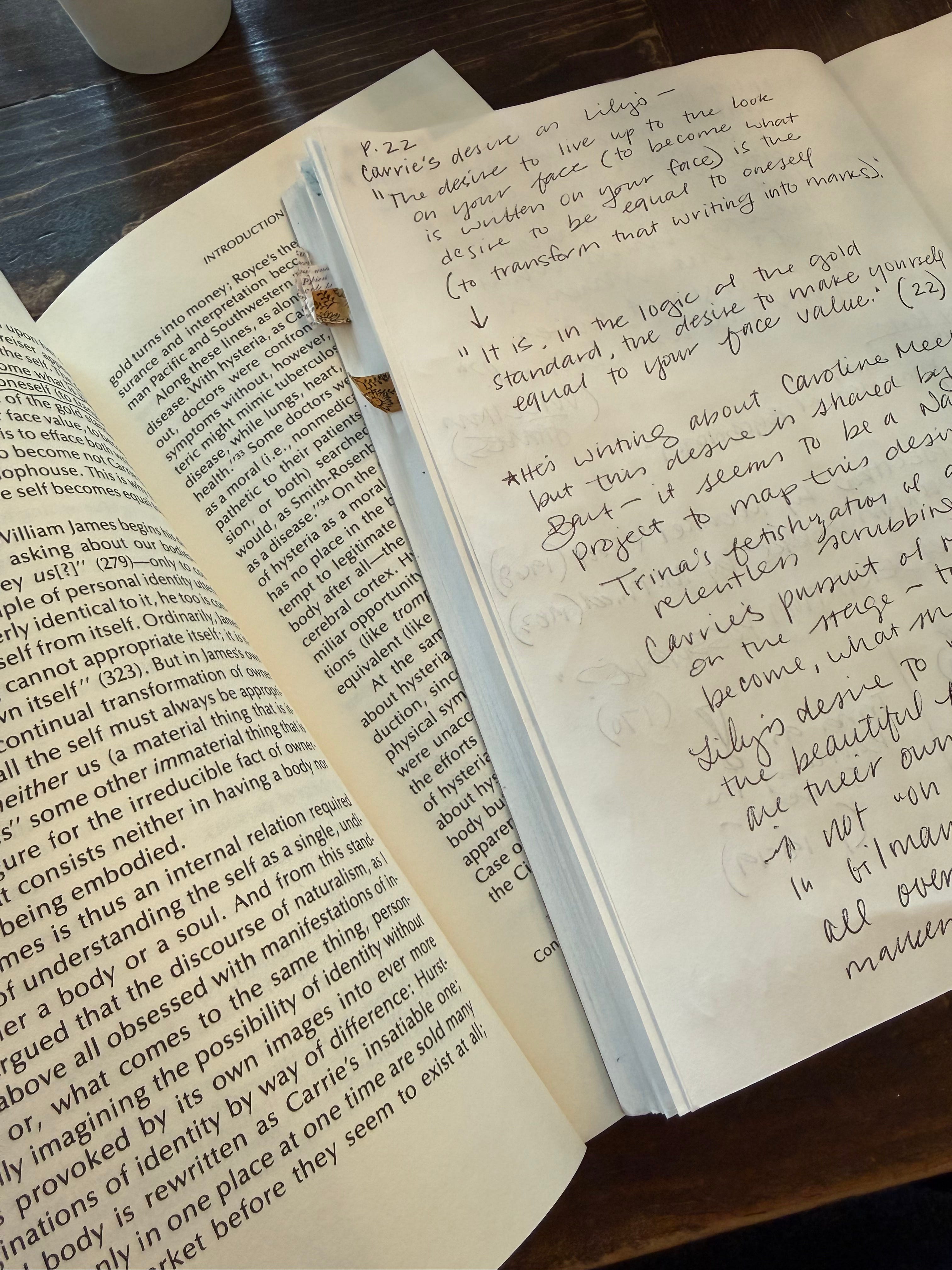
And then, Michaels really drove things home by connecting this idea of writing and paper to gold and economics.
3. From gold to paper
In the novel, as in society, “paper becomes more powerful than gold,” by way of representation.
We see the power of paper especially grow at the end of the novel, when McTeague’s lack of “paperwork” to prove his dentistry education keeps him from being able to earn a living.
If Marcus felt entitled to Trina’s gold, he sticks it to McTeague by leveraging the power of paper to undo their financial situation.
As Michaels puts it: professionalization of trades happens thanks to “governmental alchemy,” that turns paper into gold, in the sense that it transforms a piece of paper into a living.
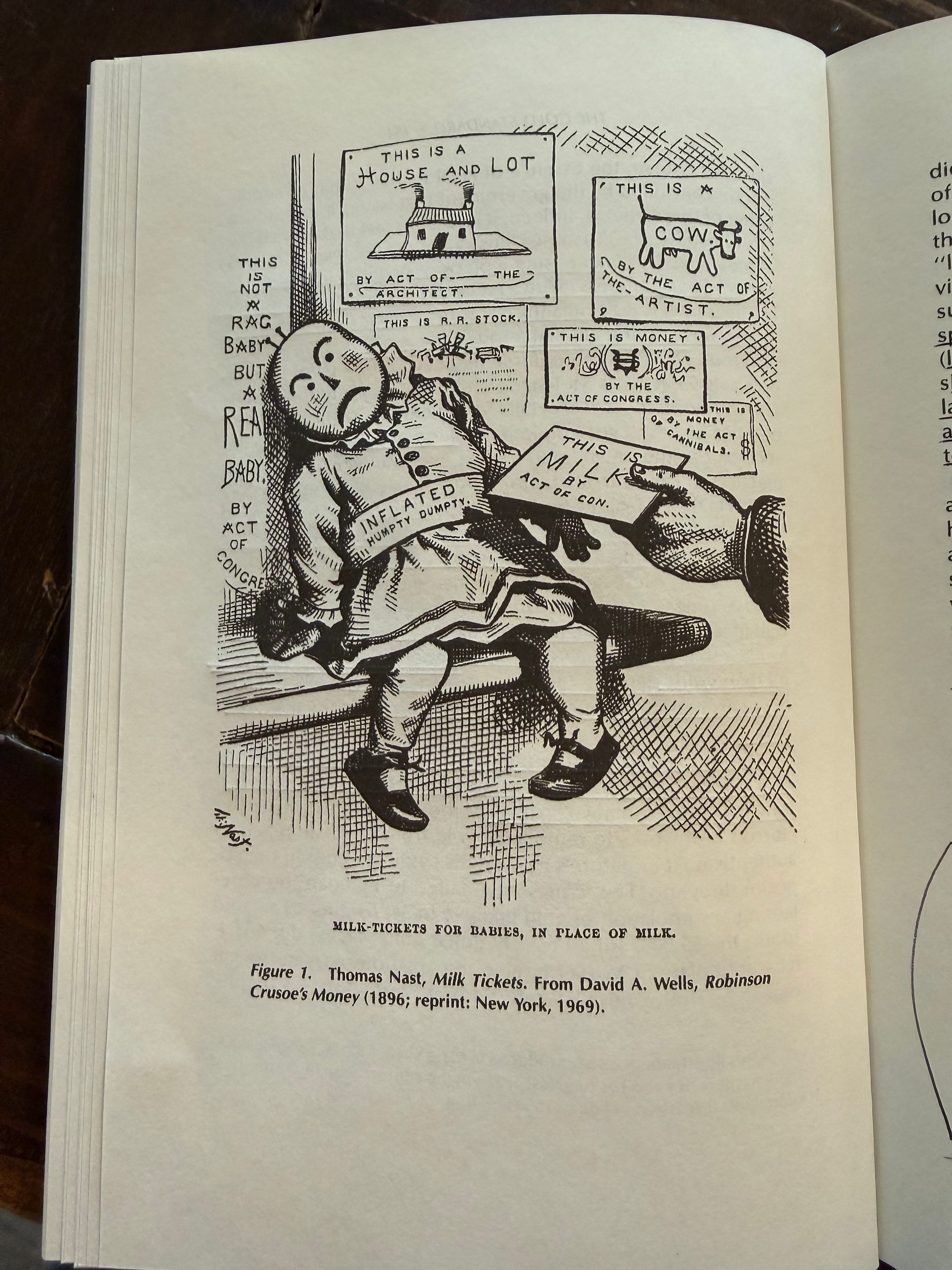
The comic below, included in Michaels’ essay, showcases an 1896 reaction to the rising power of representational economics, in which paper could assign identity and meaning that was not inherent.
I can’t help but make a connection to Magritte’s Treachery of Images.
There are so many reasons to read good academic criticism after you finish a book like McTeague. For one, this deep dive into the genre of Naturalism helps evolve our understanding of the genre — even if you haven’t read all the touchstone pieces Michaels analyzes, there’s so much to be learned from reading books like this one.
Another reason I like to read academic prose is because it’s hard to read. Sometimes, people will say academics are “needlessly dense” or pretentious in tone or whatever. I tend to believe the people who say that have never earnestly read academic prose, because when you do pay attention to it, on a deeper level, what looks like density or pretension is actually a rather dedicated approach to creating understanding.
Pretentious might just be what we call things that are precise in the extreme — careful, intentional, and meaningfully crafted.
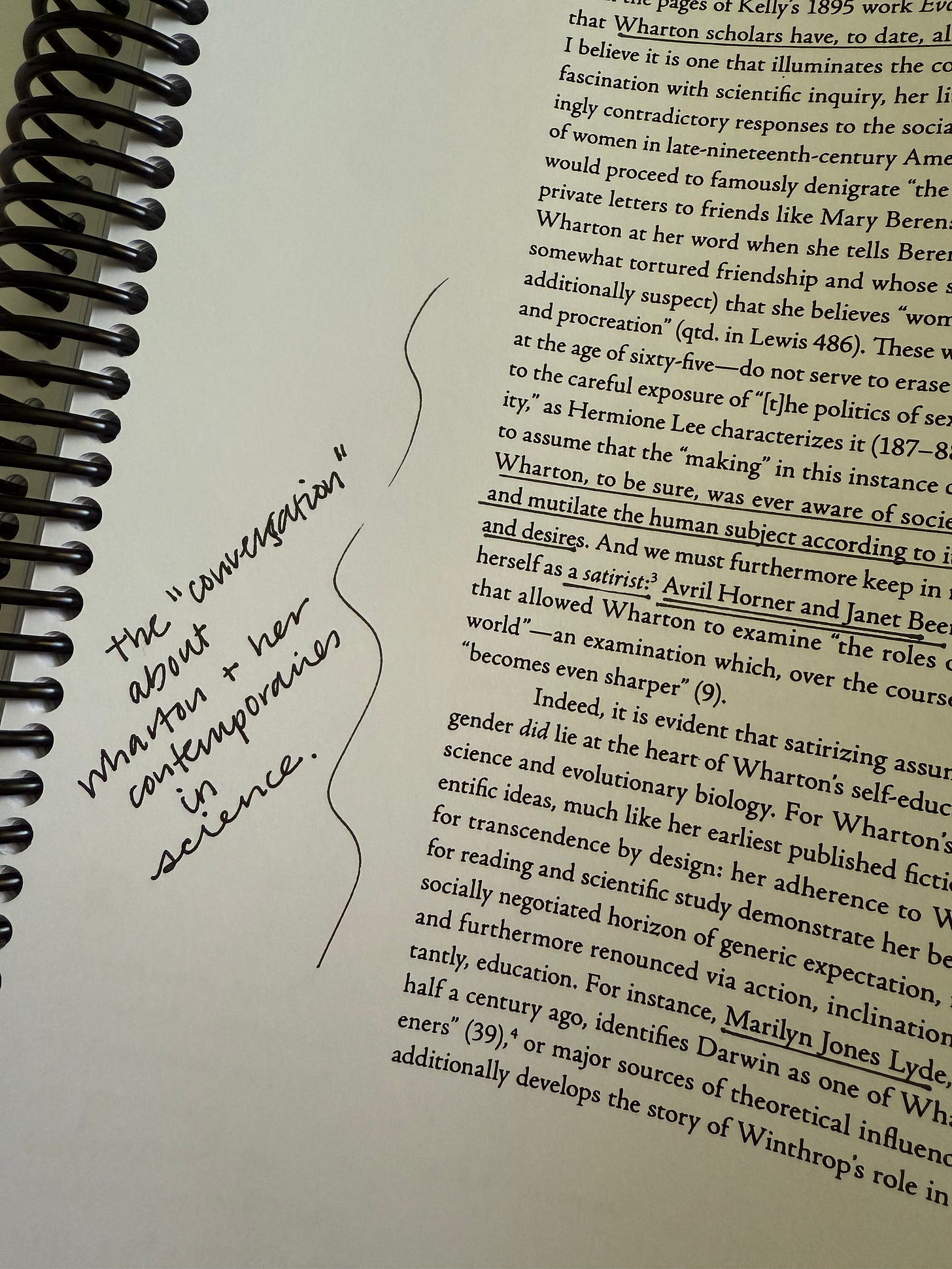
Reading academic prose can wake up the parts of your brain that sit dormant, collecting cobwebs. (It’s shocking to me how quickly those webs can accumulate!) Sitting with a “difficult” analysis is an invitation to dig in, take some notes by hand, and see where you can find crossover between your own reading experience and the deep thinking from someone who hasn’t just read the book, but who has devoted years of research and time and energy to understanding it (and then bothered to sit down and make it legible for us to learn from).
Of course, there are always blowhards to watch out for. But I’d never recommend their work. ;)
If you’re looking for an endlessly interesting scholarly look at the novel, validated by precise and thoughtful analysis, and tied closely to the themes we’ve been discussing together, I can’t recommend The Gold Standard to you enough.
Michaels answered my most burning questions, and he did so in a way that had me realizing all my questions were really one big question —
“Why does the miser save? He saves to escape the money economy; he saves to reenact for himself the origin of that economy. How can metal become money? How can paint become a picture? One set of answers to these questions repeats the escape from money: metals never do become money; they always were; hence they never are; a picture is just paper and paint pretending to be something else. The logic of these answers is the logic of goldbugs and Byranites, trompe l’oeil, and a certain strain of modernism.” (169)
Love this piece? Pick up a copy of Michaels’ book.
I’ve been continually adding to our shelf for this year’s Closely Reading selections. You’ll find books in conversation with McTeague, literary naturalism, appetite, American desperation, gothic inheritance, tenderness, violence, and longing.
→ Browse the full shelf: 2026 Closely Reading Book Club Reads

I’m off to play a bit of a video game, snack on olives and pickles, and think about our next read — The Grapes of Wrath schedule drops this weekend!
Project Gutenberg has the whole thing, free to read online.