
Hunting for the best backsides in the library
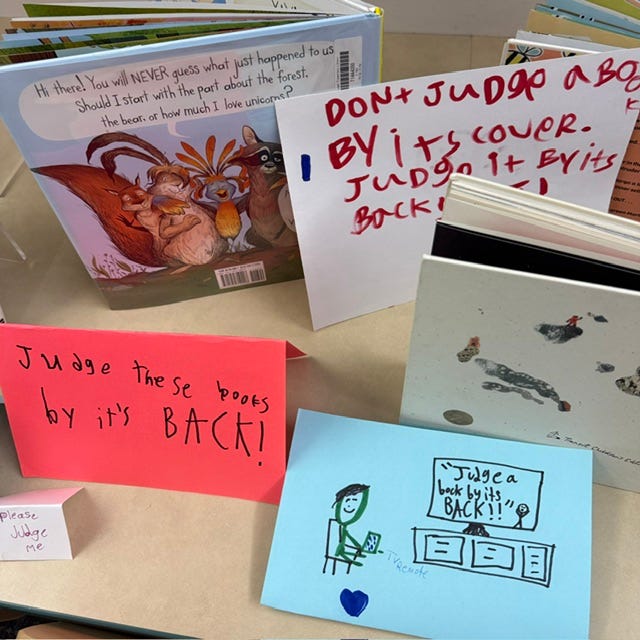
This spring, one of the things I’ve gotten curious about in the library is back covers.
On my end, I’ve grown increasingly frustrated by back cover designs (particularly on picture books) that are log-jammed with text-heavy blurbs and starred reviews. The prose style and density do not match the reading experience inside, and are often inaccessible to the actual kids the book is written for. What gives?
When I as a grown-up have a question or frustration about kid’s books, though, I try to run it back via the essential filter: the words and behaviors of actual kids.
And so, amidst the hubbub of my days in the library, I’ve been watching. Chatting. Experimenting. And today I’m sharing my reflections with you, via three questions:
Do back covers matter to kids?
Should they?
Can they?
Do back covers matter to kids?
Functionally, no.
Not at all.
In my anecdotal observations, kids did not so much as glance at back covers when making decision during checkout time. 100% looked at front covers, and many went to the interior pages — either flipping through or slowing down to read a page or two. I saw a grand total of zero kids look at back covers or flap copy between picking a book up and checking it out (or rejecting it). For context, I serve just shy of 500 elementary school kids per week.
So why the short shrift for back covers? There’s room to interrogate this question further, but my theories center around expedience, past experience, and habit. In the era of algorithm-driven entertainment, kids are trained to determine preferences in binary — and fast. They decide in seconds if a video is worth watching, or they click to the next. So too with books — if their instantaneous judgment of a front cover doesn’t jive with their nebulous preferences, most kids reject it outright and continue the scroll. In terms of habit, I think many kids have enough past experience picking up books and seeing a wall of unengaging text on the back that they train themselves to ignore it (with good reason).
Should back covers matter to kids?
This question veers a bit more philosophical for me, and implicitly summons several other questions alongside it.
To me, a children’s book is an object for a child. As such, its design — on all sides — should hold the child central and aim to serve their experience. A back cover, well designed, should give just enough to make a child wildly curious about what’s inside — and no more. Whether an image, a phrase, a sentence or two — it’s a provocation to drive them further into the book.
If this were the priority of the grown-ups designing the books, then yes, by jove, back covers both can and should matter to kids.
Publishers, of course, need to make money. To do so, they need to sell books to customers: mostly grown-ups. And back covers have become de facto real estate to market the object to grown-ups. I acknowledge this tension, but I challenge its premise. Do the adults doing the buying give consideration to these oceans of back cover copy, or have they trained themselves to ignore it just like the kids? (I know I have.)
I also can’t resist a thought exercise that is both silly and serious: would you as a consumer, when buying an object for yourself, want the marketing copy printed indelibly right there on the thing? And worse — what if someone were buying all your somethings for you? Would you want their reasons printed all over your stuff?
Say someone bought all your clothes for you — would you want reasons geared at them, often convoluted and contradictory, printed on your sweater and your jeans, let’s say on the backside? “100% cotton. No micro-plastics. Durable. Extra-soft fabric technology. Made from recycled water bottles.”
But, in effect, this is what we do to books for kids.
Can back covers matter to kids?
Here’s where it gets fun. (And I discovered a resounding hell yes, back covers can matter to kids.)
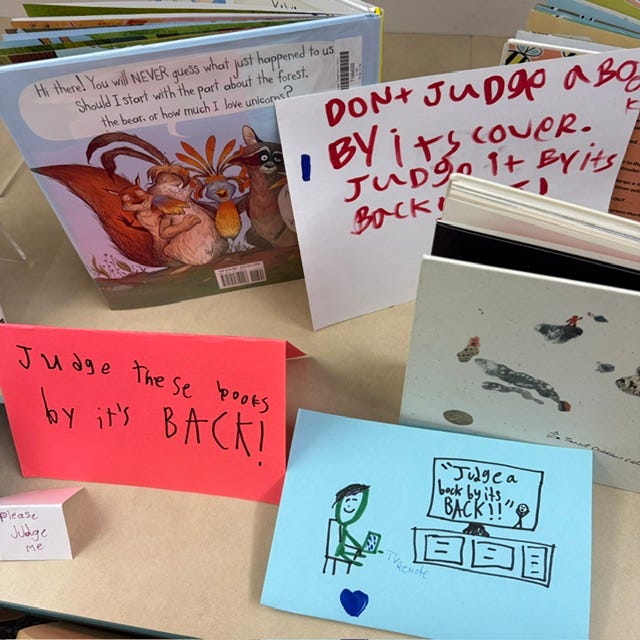
I asked my fifth-grade library leaders: Is it possible for a back cover alone to convince you to check a book out?
I challenged them to go on a hunt for the best backsides in the library, then build a display to entice their fellow readers to take the back cover challenge, too. Here’s a peek at what they came up with: