

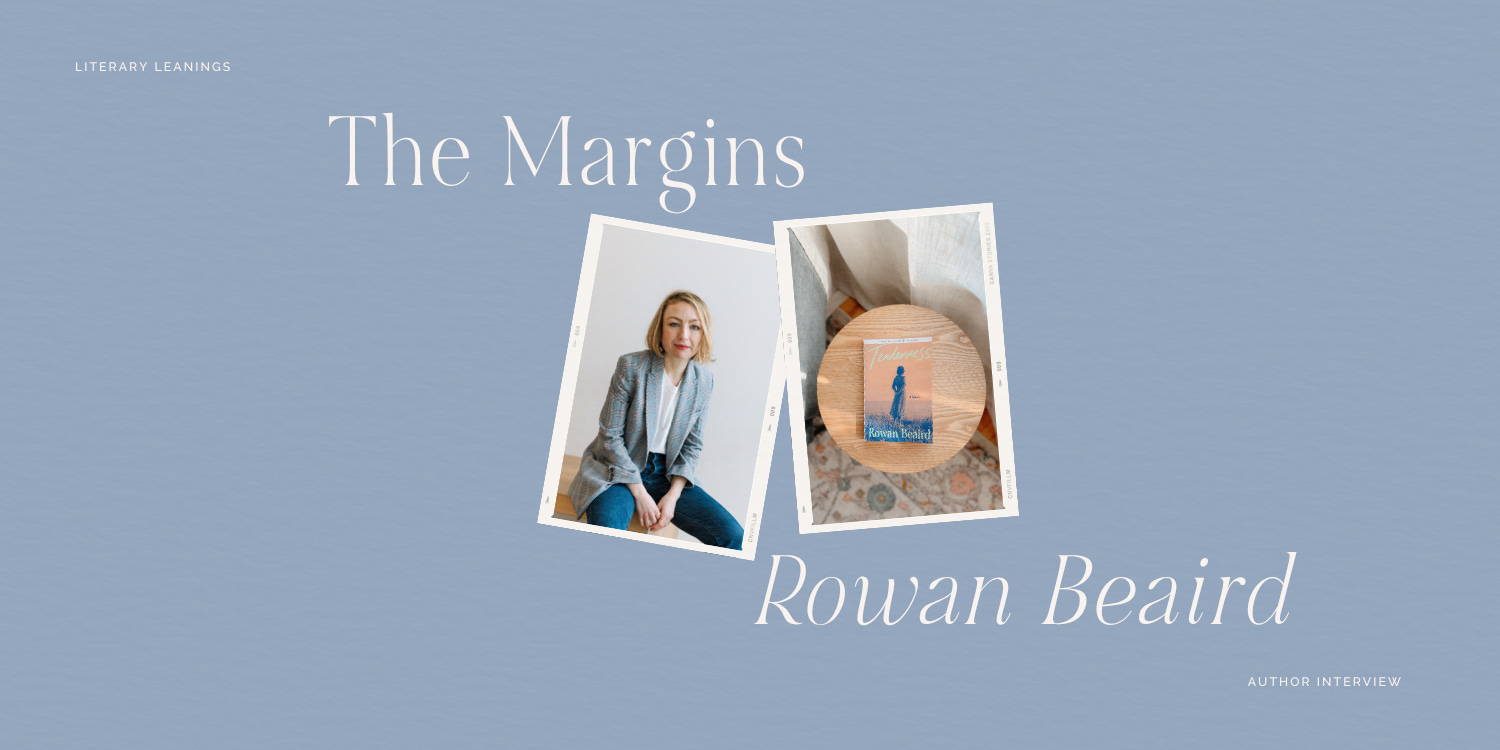
The Margins: Rowan Beaird
This is The Margins: a series where I get to sit down for casual conversations with my favorite authors about their books, their writing lives, and, of course, their book recommendations.

Most summer weekends for the past five years, I can be found at a wedding. As a photographer, I spend the day witnessing the family dynamics at play and documenting all the emotions that come with a wedding day.
Photography may be my medium, but after so many weddings, I sometimes think I’ve also been unknowingly collecting material for a novel. I’m not sure if I’ll ever write one. But if I do, I have a feeling it’ll be a wedding novel.
So when I heard about Rowan Beaird’s new novel, Tenderness—a 1970s island wedding where the bride has recently escaped a cult that may or may not be following her—I knew I wanted to read it. I love seeing how different authors use weddings as the backdrop for stories. They’re naturally full of family history, old tensions, high expectations, and just enough chaos that the plot can go anywhere.
Tenderness leans into that atmosphere of subtle chaos. It’s a quieter novel, a little unsettling, and threaded with a sense that something isn’t quite right from the very first page. It pulled me in from those first sentences.
Below, Rowan and I talk about the real wedding that inspired the novel, her writing process, how she builds suspense without rushing, and, of course, the books she’s been loving lately.
Hi Rowan! Thanks so much for joining us for this issue of The Margins. I’m so delighted to have you here. Congratulations on the publication of Tenderness! For readers who may not know you yet, could you introduce yourself?
Thanks so much for having me, and of course! I’m Rowan Beaird, a novelist whose first book—The Divorcées—came out in 2024 and was named a best book by some amazing publications like People, Harper’s Bazaar, and Elle. I’m also a proud Chicagoan, living in the city with my husband and daughter.
Your newest novel, Tenderness, publishes this week. I was fascinated to learn that attending a particular wedding helped spark this novel. I’m a wedding photographer, and constantly thinking about how much fodder for writing there is at weddings. I’m always curious about those moments when an ordinary experience becomes the seed for fiction. What stayed with you after that wedding, and how did it eventually evolve into Tenderness?
I’m sure as a wedding photographer, you have so many stories! So yes, in my late twenties and early thirties, I felt like I was going to weddings every other weekend. Most of these were lovely, joyous affairs, but there was one wedding in particular where I didn’t know the bride or groom very well, and it became clear to me upon arriving that many people did not think the couple should be wed. This completely changed the tone of the ceremony. There was tension, a sense of dread, and as a writer, that made me think about the incredible dramatic potential of weddings. I wanted to explore how this life-changing moment could change someone’s life—or in my novel’s case, several people’s lives—in ways we don’t typically expect.
One of the things that surprised me most while reading Tenderness is that although the novel is put into motion by Shay’s wedding weekend, which has brought everyone to this island, it’s told primarily through the perspectives of her brother, William and Joel, a close friend with whom she has a complicated history. Did you always know this story belonged primarily to their perspectives, or did you experiment with other narrators before finding the novel’s shape?
Originally, there was only one chapter from Shay’s perspective. The book is partially about whether or not we can ever know the people we love, and so I wanted the structure of it to explore whether you as the reader could know her only through the eyes of two men who love her. It turns out, you couldn’t! And so with every draft I wrote, I added more chapters with Shay, which was its own challenge, as it’s critical to the plot that parts of her remain a mystery. This was a really great lesson for me as a writer: there are some decisions we make because of craft that have to be sacrificed in service of the story.
From the opening pages, there’s a subtle sense of dread that hangs over the novel. Nothing especially frightening is happening, but the atmosphere itself feels unsettling. Were you consciously trying to create that feeling from the very first chapter, or did it emerge as you wrote?
This was very conscious, and I’m glad you felt it! I don’t like books where a gun goes off in the first few pages; instead, I want to feel the potential for violence. I want readers to feel immersed in a setting, a situation, that feels very familiar to them (we’ve all felt that slight awkwardness entering a gathering of family and friends or traveling to someplace new), and then shift their expectations. For me as a reader, that will always create tension and intrigue.
Your descriptions are incredibly vivid and poetic. I found myself underlining so many— “she rose like oil to the surface of his consciousness” or “the party thinned and wilded”—that made the scene feel so visual to me. Do you actively collect details from everyday life, or do those images arrive only once you’re inside the world of the novel?
I’ve talked to numerous writers who have a practice of writing down sharp observations or metaphors that come to them throughout their days; this seems incredibly smart, and I’ve never done it. I have to really marinate in the book itself. This means I can be a painfully slow writer at times! For Tenderness, I did a lot of staring into the middle distance, imagining the texture of sand on a beach, the feeling of sweat slicking my back, when it was actually the middle of winter in Chicago.
The title Tenderness feels almost paradoxical against the darkness running through much of the novel. At what point did the title emerge, and what does it ultimately mean to you in the context of this story?
In the novel, Shay has recently left a cult that actually existed in the 1970s—Synanon. In my research, I discovered the original name for this organization was Tender Loving Care. I found it really fascinating that an organization which, even from its start, implemented some pretty brutal practices would ground itself in this idea of tenderness.
I think trauma makes us cognizant of our vulnerability, and often in response to it, we harden ourselves. Tenderness explores this response—how it can protect us, in some ways, and how in others, it can cut us off from the world. I think to heal from any episode of grief or harm, we have to be our most tender selves.
While reading, I kept thinking about novels that create tension through mood more than plot. Were there any books, films, artists, or other influences that helped shape the emotional atmosphere of Tenderness?
So many! I obsessively reread Susan Minot’s Evening, a novel that tells the entire story of a woman’s life through memories of a wedding she attended when she was in her twenties. It’s so rich; often more like poetry than prose. Emma Cline’s The Guest and The Girls. The dreamy atmosphere of Sofia Coppola’s movies, the menace of horror classics from the ‘70s, like Picnic at Hanging Rock. And music! I always create a playlist for books I’m working on that evoke the mood I’m trying to capture.
And, of course, I’d love to ask you for some book recommendations. What’s a book you find yourself recommending again and again?
Less by Andrew Sean Greer. It’s impossible for me to imagine someone not laughing and crying while reading it.
What’s a book you love that you think more people should know about?
Anything by Shirley Hazzard!
And finally, what’s the last truly great book you read?
So hard to choose, but I’d say The Wilderness by Angela Flournoy. The book I’m working on now takes place over 25 years, and how she moves through time in this novel is really astonishing.
Thank you so much, Rowan! I loved hearing more about the inspiration for Tenderness and what inspired you. And you’re the second author to recommend Shirley Hazzard in this series, so I’m thinking it’s time I finally read something by her!
You can learn more about Rowan and her work on her website and follow her on Instagram.
Are you planning to read Tenderness? I’d love to hear your thoughts below!
Until next time,